- 817-587-4286
- info@treeservicegrapevinetx.com
- Mon - Sat: 9:00 - 18:00
Removing a Whole Tree From a Property That Stays Open
Commercial Tree Removal in Grapevine, TX
Taking down an entire tree on business grounds means working around buildings, parking, and the people who use them. Commercial tree removal starts by pinning down which tree is coming out, where it stands, and what the site around it needs to keep doing.
Call 817-587-4286 to request an estimate.
Identify the Tree and Request an Estimate

Identify the Tree and the Reason for the Request
Most commercial removal requests already have a reason behind them, such as a planned change to the property or another practical goal. Whatever the reason, the request gets clearer with a few details:
- Which tree is involved
- Where it stands on the property
- Its approximate size, if known
- What is built or planted around it
- Whether other trees are part of the request
- Whether stump work is wanted
- Any access limits
No one needs to diagnose the tree. The goal is simply to define what is being removed.
Where the Tree Stands Can Change the Removal Scope
A tree beside a building wall is a more complex removal than one in a back corner of the lot. On commercial grounds, a tree might stand next to a building, near parking spaces, by an entrance, along an internal drive, in a landscaped island, beside a fence or property edge, or in a less-used part of the site.
Whatever sits around the trunk guides the plan for bringing it down. Being near any of them does not, on its own, make the tree a hazard.
A Tree Beside a Building Does Not Automatically Need Removal
Standing close to a building, a sign, a parking lot, an entrance, or a walkway does not by itself prove a tree is dangerous or has to come down. Structural problems, disease, and failure risk can’t be read from location alone, and this page is not a formal risk assessment.
If removal is the plan, it should be because the owner or manager has decided it fits the property’s goals, not because closeness to something was treated as proof.
Parking Areas Can Become Part of the Work-Area Question
When the tree stands near parking, the removal plan has to account for parked vehicles, the path crews use to reach the tree, and the people walking between cars and the building. A section of the lot may need to be set apart as a work area while the tree comes down.
This page does not cover parking management, traffic control, towing, or road closures, and continuous parking availability can’t be guaranteed. Branches over parked cars are not, by themselves, a reason to remove a tree.
Entrances, Drive Lanes, and Service Areas Need to Be Identified
For a whole-tree removal, it helps to name exactly which busy areas sit near that particular tree. Depending on the site, that might be a customer or employee entrance, a driveway or internal drive lane, a service or loading area, or a pedestrian route.
Not every property has all of these, and uninterrupted access through each one can’t be promised. Knowing which areas matter most lets the removal be planned with them in mind.
Multiple Trees Should Still Be Defined Individually
When several trees are being considered for removal, they shouldn’t be lumped into one generic job, and no extra tree should be added just because another one is coming down.
Which Trees
The scope should name each tree included and where it stands.
What Work
It should say whether the same removal work, and the same stump work, applies to each one.
What Access
Different trees can come with different access issues, and the scope should note them.
Property Edges Require Clear Authority and Access
Removing a tree near a fence, a neighboring business, an adjoining lot, or a boundary that only looks shared needs a clear answer about who is authorizing the work and where crews can stand.
Access through neighboring property can’t be assumed. Nothing on this page covers surveying, deciding legal lines or who owns a tree, settling disputes, getting a neighbor’s sign-off, or legal advice. If an uncertain boundary affects the removal, the responsible party may need records or a licensed surveyor to confirm it.
Overhead Utilities Change the Situation
If the tree is near energized power lines, no one on site should try to cut or pull it down on their own. Texas A&M Forest Service advises against taking down limbs that are on or near power lines.
The electric utility is the right call for lines near the tree, and 911 is the right call for a downed line. This page does not cover line clearance, utility vegetation management, or moving utility lines.
Tree Removal Stops Above Ground Unless the Stump Is in the Scope
On a commercial site, what is left at ground level can matter for mowing, landscaping, or future plans. Each piece is its own decision:
- Tree removal: the above-ground tree, as agreed
- Stump grinding: a separate stump service
- Stump removal: a separate, more extensive stump goal
- Tree root removal: separate root work, only where it fits
None of these comes bundled in automatically. Grinding doesn’t clear all roots, and root work isn’t always needed.
What Does the Property Need After the Tree Is Gone?
Before work starts, it is worth asking what condition the area should be in once the removal scope is finished. Tree removal does not automatically include grading, excavation, paving or concrete work, parking-lot repair, landscape or irrigation repair, drainage work, construction prep, or planting a new tree.
If the space is headed for another use, those steps need their own plan. A cleared spot is not a construction-ready one.
Cut Material Needs Its Own Scope
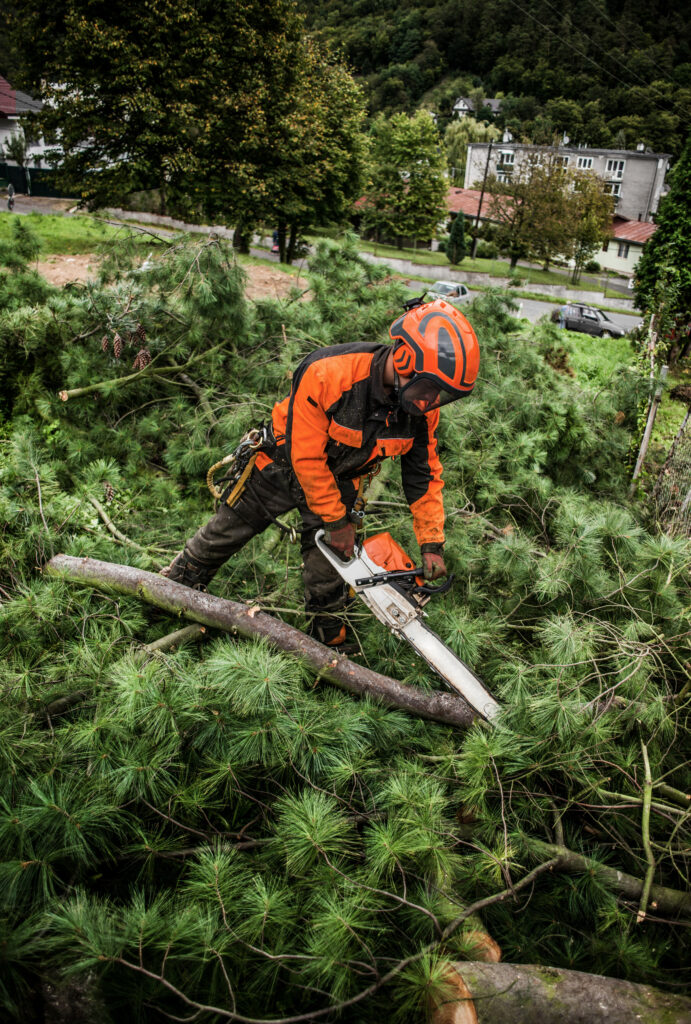
Taking down a whole tree produces branches, limbs, trunk sections, and woody debris, often more than people expect. How that material is handled should be settled in the agreed scope.
Don’t assume any particular method. If the property has preferences about where wood is staged or when it leaves, mention them when requesting the estimate.
Commercial Removal Does Not Mean a Commercial Contract
Asking for a commercial tree removal does not tie the property to an ongoing arrangement. This page is not about maintenance contracts, property-management or HOA agreements, corporate accounts, municipal agreements, recurring service plans, or multi-property contracts.
It is about one defined removal project, estimated on its own.
Grapevine Rules Can Depend on the Property and Project
Grapevine’s tree preservation ordinance, Section 52, can apply to commercial sites, but what it requires depends on the tree and the situation. The city’s Tree Preservation page links to the ordinance and its removal application.
The posted ordinance defines a protected tree by trunk size, generally 3 caliper inches or larger at 4½ feet above the ground, and taking one down from covered property calls for a Protected Tree Removal Permit unless a listed exception applies. The city’s page adds that trees removed without a permit carry a replacement payment, and that certificates of occupancy are held until that payment is made when work went ahead without approval.
This is not legal advice, and not every removal falls under these rules. Confirm with Grapevine Planning Services before a commercial tree comes down.
What Shapes a Commercial Tree Removal Estimate?
No two commercial removals are priced alike. What goes into the estimate:
- How many trees are included, their size, and where they stand
- Access and parking constraints
- Nearby buildings, entrances, and routes
- Gates, fences, and neighboring property
- Terrain and separate work zones
- Whether stumps are part of the job
- What happens to the cut wood
- Practical timing around property use
Call 817-587-4286 to request an estimate.
Related Work Before or After Removal
For the wider picture, see tree removal in general, or our commercial tree service page for other work on business grounds. When weather already knocked the tree over, storm damage cleanup is often the closer match. Everything we do is listed under our tree services in Grapevine.
Identify the Tree, Its Location, and the Property Constraints
Tell us where each tree stands, how many are involved, and roughly how big they are. Note nearby buildings, parking and access areas, entrances and routes, fences or property edges, any overhead lines you can see, whether stumps are included, how you'd like the wood handled, and any timing needs. Call 817-587-4286 to request an estimate.
Questions Before Removing a Tree From Commercial Property
No. Closeness alone doesn’t prove a tree is unsafe. Removal should reflect the property’s own goals.
Yes, as long as each tree is named and its work, stump needs, and access are spelled out.
Only if the estimate lists it. Grinding the stump is its own line item, separate from taking the tree down.
Part of the lot may need to serve as a work area. Which spaces are affected should be discussed ahead of time.
Say so early. Access through a neighbor’s property can’t be assumed, and an unclear boundary may need records or a surveyor.
The estimate should say. Agree on what happens to the wood, whether it is staged on site or leaves, before the first cut.
No. A removal is estimated as its own defined project, with no ongoing agreement attached.
Request a Commercial Tree Removal Estimate
We’re dedicated to providing quality tree care for the Grapevine, TX area. We offer tree trimming, pruning, tree removal and stump grinding for homes and businesses. Our goal is to keep your property safe and your trees healthy. We plan every job with safety in mind and aim for clean, professional work. Whether you need routine care or emergency tree work, Tree Service Grapevine Texas is here to handle all your tree care needs with expertise and reliability.
CONTACT US
- Grapevine, Texas
- 817-587-4286
- info@treeservicegrapevinetx.com
- 9 AM to 6 PM (Monday to Saturday)
Copyright 2026 Tree Service Grapevine Texas| All RIghts Reserved